Summary
Humak University of Applied Sciences specializes in educating professionals in community education, cultural production and sign language interpreting. As one of three CCC (Creative Circular Cities) partners in Turku, Humak organized an Idea Incubator to address a pressing challenge: How can concerts, festivals, theatre productions, and other events become more sustainable through circular economy tools?
To tackle this, Humak implemented a four-month Idea Incubator (January to April 2025) in Turku. The program was facilitated by a professional and structured around cross-sectoral teams, each comprising:
- A representative from the experience industry (e.g., festivals, theatres, catering suppliers)
- An artist
- Circular economy experts and students
This multidisciplinary approach ensured that each team combined practical industry knowledge, creative thinking and circular economy expertise. The results primarily focused on making circularity visible, often through artistic and innovative methods.
About the Organization/Partner
The industry organizations involved in the incubator included a music festival, a theatre and an event catering supplier. These organisations were micro and small size organisations employing teams ranging from a few individuals to a few dozen. Despite their size, they serve large audiences, making their operations a significant source of waste generation (e.g., disposable plates, cups, and other single-use items).
The Challenge
The participating organizations shared a common challenge: managing large-scale events that often generate substantial waste, particularly from disposable materials. While they had already implemented basic circular practices (the “low-hanging fruits”), they sought fresh ideas and innovative solutions to further advance their circular economy efforts.
The core question was: How can the experience industry reduce waste and promote sustainability while maintaining the quality and appeal of events?
The Solution
The Idea Incubator followed a structured, three-phase process:
1. Planning Phase
- Ideation: Brainstorming potential challenges and opportunities.
- Resource Allocation: Securing necessary tools, budgets, and materials.
- Marketing: Promoting the incubator to attract diverse participants.
- Recruitment: Selecting participants from various backgrounds to ensure a balanced mix of industry, artistic and circular economy expertise.
2. Implementation Phase
- Challenge Definition: Identifying specific circular economy challenges faced by the experience industry.
- Team Formation: Creating cross-sectoral teams with balanced expertise.
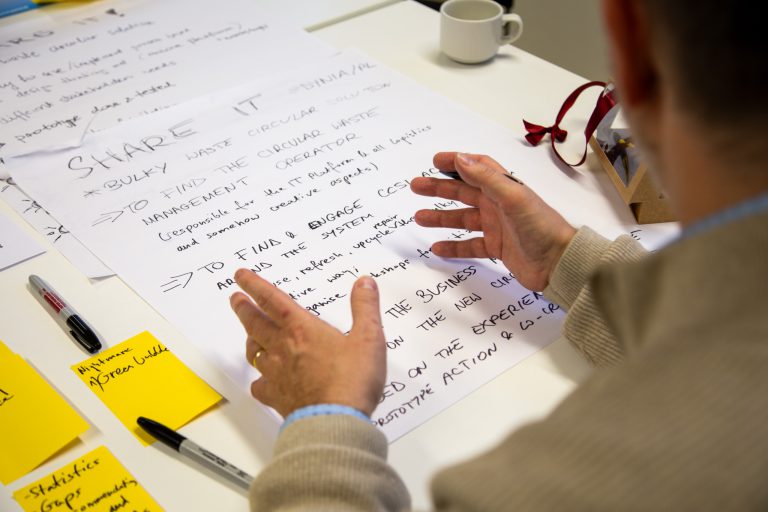
- Creative Ideation: Generating a wide range of ideas (focusing on quantity).
- Solution Refinement: Selecting the most feasible and impactful ideas (focusing on quality).
- Pilot Preparation: Planning the logistics for testing the ideas in real-world settings.
3. Piloting Phase
- Logistics: Determining the time, place, budget, and audience for each pilot.
- Feedback Collection: Gathering insights from participants and attendees.
- Iteration: Refining the ideas based on feedback.
Key Strategies for Creative Solutions:
- Multidisciplinary teams: Ensuring each team included members from diverse backgrounds (e.g., using color-coded roles to balance expertise).
- Time for team Formation: Allowing participants to find like-minded collaborators during the grouping phase.
- Professional facilitation: Engaging a skilled facilitator to guide the process.
- Open atmosphere: Fostering a relaxed, discussion-friendly environment where all ideas were welcome.
- Encouraging wild ideas: Using techniques like “Yes, and…” (instead of “But…”) to promote out-of-the-box thinking.
The Results
Participation:
- 23 participants started the incubator.
- 20 participants completed the program.
Participant Learning Outcomes: The incubator improved participants’ understanding of:
- Circular Economy in Their Professional Field
- Pre-Incubation: Most participants had a basic or moderate understanding.
- Post-Incubation: A marked increase in confidence and knowledge, with many reporting a “High” or “Very High” understanding.
- Integrating Art into Innovation
- Pre-Incubation: Limited familiarity with artistic approaches in innovation.
- Post-Incubation: A substantial improvement, with participants recognizing the value of creativity in developing circular solutions.
Team Outcomes: The incubator produced four innovative concepts, each piloted at the ReTurku Circular Carnival (organized by CCC partner Valonia). While the concepts did not introduce entirely new circular practices, they creatively visualized circularity and incorporated artistic elements, aligning with the CCC project’s goals of combining Culture and Creative Sectors and Industries (CCSI) with circularity.
Piloted Concepts:
- Ice-Cream for End Times
- A carnivalesque performance featuring an ice-cream parlour with unconventional flavors (e.g., microplastics, cyanobacteria, antibiotics).
- Goal: Spark conversation about sustainability and consumption through a provocative, sensory experience.
- Zero Waste Experiment
- A future-oriented event where disposable items (e.g., cups, plates) were banned.
- Participants brought their own dining and cleaning utensils (e.g., soap, towels).
- Goal: Demonstrate the feasibility and benefits of zero-waste events.
- Spoon Movement: “Bring Your Own Spoon, Get a Slice of Cake!”
- After a shared cake moment, spoons were collected and repurposed into a community art piece, a “spoon tree” displayed at the Knit’n’Tag Turku event.
- Goal: Encourage reusable practices while creating a symbolic, collaborative artwork.
- Sound Art Piece
- Visitors wrote thoughts and experiences about the circular economy on a bulletin board.
- These writings were later transformed into a sound art piece.
- Goal: Capture and amplify public reflections on circularity through artistic expression.
The concepts created by the teams were piloted in the ReTurku Circular Economy Carnival, organised by another Creative Circular Cities project partner Valonia. You can read about the Carnival here: https://www.creativecircularcities.com/case-studies/returku-circular-economy-carnival/
Instead of new concepts for circularity, the outcomes made circular economy principles tangible and visible to the public.
Most of the concepts also contained essential artistic elements, which highlighted the role of creativity and art in promoting circularity. In this way the outcomes of the idea incubator also align with the objectives of the CCC project, combining creative and cultural industry and circularity.
Key Takeaways
Success factors:
- Multidisciplinary teams: The inclusion of artists and circular economy experts brought fresh perspectives, leading to creative and visually engaging solutions.
- Preparation: Adequate time for planning, marketing, and recruitment was crucial.
- Communication: Clear, timely, and precise information for participants ensured smooth collaboration.
Lessons learned:
- Clarify objectives: When recruiting company representatives, emphasize that the incubator’s goal is to benefit the industry collectively, not individual businesses. This could have been communicated more clearly.
- Art as a catalyst: The artistic elements in the outcomes demonstrated the power of creativity in making circularity accessible and engaging.
Inspirational Quotes
“Culture has the potential to expose individuals to circular economy and sustainability, and in this way, to change their thinking more toward circularity and circular economy models.”, Eerika Heinonen, Project Planner, Turku University of Applied Sciences
“It’s great when we can create something together, from different starting points.”, Jani Turku, Facilitator, Ideapakka (on multidisciplinary cooperation)
“Multidisciplinary cooperation gave me new points of view, new experiences, and the ability to, rather than thinking outside the box, think out of someone else’s box.”, Mike Valtonen, Marketing Coordinator, Turku Music Festival
Call to Action
Explore the incubator’s process and outcomes:
- ThingLink Tool: Incubator Process
- Micro Course: Cross-Sectoral Innovation (includes photos and videos)
Business Model/Financing
The total costs (including VAT) for the Idea Incubator were covered by the CCC project. Total: €12,300.
- Venue & Catering (5 meetings): €2,600
- Facilitator: €6,700
- Video & Photo Documentation: €3,000
Visuals, Charts, and Photos
- Incubator process (ThingLink)
- Cross-Sectoral Innovation (micro course)